Dengan nama ALLAH, Yang Maha Pemurah lagi Maha Penyayang. Demi Masa! Sesungguhnya manusia itu dalam kerugian. Kecuali orang-orang yang beriman dan beramal soleh, dan mereka pula berpesan-pesan dengan kebenaran serta berpesan-pesan dengan sabar. [Surah Al-'Asr Ayat 1-3]
Showing posts with label machu picchu. Show all posts
Saturday, 26 October 2013
Tourists fly out
sumber dari: thehindu.com
IES Abroad Santiago students at Machu Picchu
Machu Picchu preservation
The president of the Association of Cusco Tour Agencies says he’s concerned that poor management and overcrowding at Machu Picchu is taking an undue toll on the iconic Inca citadel, and he blames the Ministry of Culture.
Enrique Velarde told Peru’s tourism trade publication T News that the Culture Ministry is taking too long to update the Machu Picchu Master Plan. He said the ministry is dragging its feet on improving Machu Picchu’s tourist infrastructure and implementing new rules for visitors aimed at preserving the World Heritage site.
“It seems like they want it all to collapse,” Velarde was quoted saying.
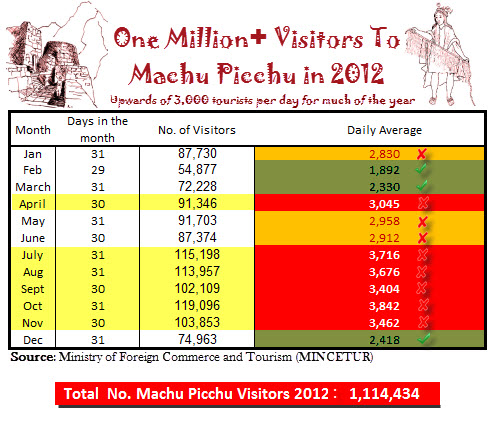
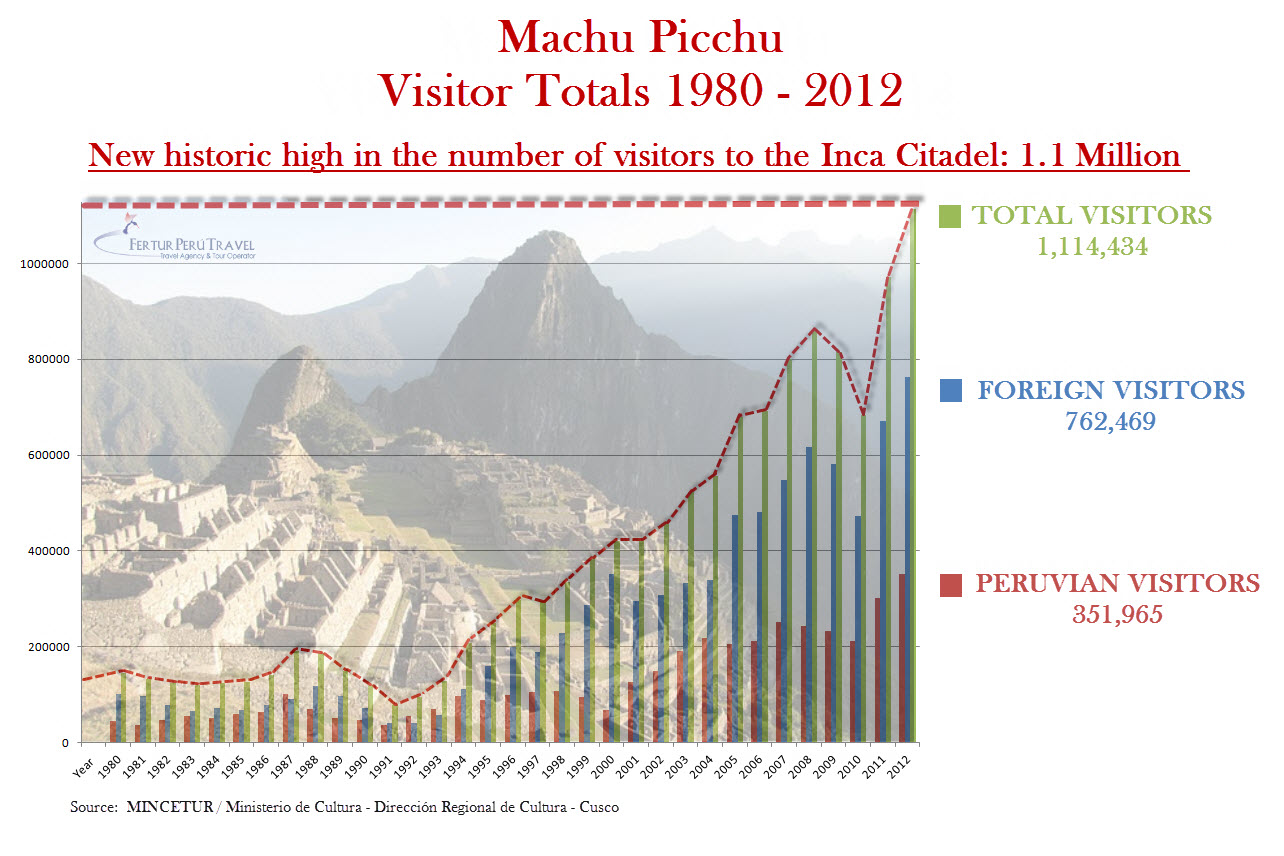
The number of visitors to Machu Picchu surpassed one million tourists for the first time ever in 2012, according to totals published by the Ministry of Foreign Commerce and Tourism (MINCETUR).
The statistics show that during all but three months of last year, the average number of visitors far exceeded the daily limit of 2,500 agreed to by Peru and UNESCO. Crowds swelled to well over 3,000 people per day during the months of April and July through November.
For years, Peru’s tourism sector has pushed for a re-evaluation of that 2,500 visitor limit at Machu Picchu, arguing that carrying capacity could be doubled or even tripled, but only if steps are taken to thin out the concentration of people trampling through at any one time. One measure would be establishing predetermined routes through the ruins to control foot traffic. Visitors would enter in shifts spaced out across the day. Another would be to create a new entrance, and a separate exit point.
sumber dari: fertur-travel.com
Machu Picchu (Historia para niños)

sumber dari: historiadelascivilizaciones.blogspot.com
Inca Trail Marathon
The Official 26.2 Mile Inca Trail Marathon and Mini Marathon takes running travel to a whole new level — literally. The second annual edition of the mountain-high race takes off on August 15, 2013 as part of a nine-day Peruvian adventure organized by Erik’s Adventures, an adventure travel company run by avid marathoners and personal friends of mine, Erik and Myra Rasmussen.
The race traverses the footpath the ancient Incas used to commute between Cusco, Peru and the world famous citadel of Machu Picchu. The professionally measured 26.2-mile course reaches an elevation of 13,800 feet and usually takes the typical hiker three days to complete.
Last year’s men’s winner, Ryan Maxwell, finished in 7:44:05, and women’s winner, Megan Murray, finished in 9:57:59. Runners have just 12 hours to complete the course and could face temperature swings from as low as 32 degrees to as high as 80 degrees. But the payoff is worth it: a photo finish in front of Machu Picchu.
“We are an organized race,” said Myra Rasmussen. “We have aid stations, we have porters along the way in case anyone gets lost and we have bibs so that we can identify our runners at all the checkpoints. We try to make this as seamless as possible.”
Rasmussen and her husband Erik are no strangers to Peru. Both are Spanish-speakers with deep ties to the country. Myra’s father hails from Peru and she grew up visiting family there often. And Erik, the founder of Erik’s Adventures, has been leading hikes on the Inca Trail since 2006. They’re both competitive ultra runners and marathoners with Boston Marathon qualifying times.
sumber dari: communities.washingtontimes.com
Two Main Geologic Faults Associated with Machu Picchu
sumber dari: waterhistory.org
Make My Day
When you're on the side of a mountain in the middle of a range chock full of them, dusk turns to darkness in an instant. We were on hour six of our four hour hike, our large group of 25 people, was now two or three smaller groups, walking the same treacherous trail. I remember having the thought or feeling of relief when the sun started disappearing. I mean, there was no way our tour guide would keep us wandering through the Andes after dark, right?
My chair was part of the lead group, my seatbelt fastened and a bandanna tied tightly around my forehead to keep my neck supported. Then there were the four grown men -- two in the front and two in the back -- lifting, pushing and even sometimes pulling my chair up and down the smallest of paths. Leading the way in our group was Kyle, a brave, unbelievably determined individual.
Kyle was not only leading our group, but the entire movement, and he was doing so with an extraordinary amount of responsibility on his back. Literally. He had Steve and Michel's son, Rivers, strapped to his back in a very well-designed and durable hiking/kid-carrying backpack. Not to mention, he was holding the one flashlight our group had packed for this four-hour day hike. I still, to this day, cannot imagine the amount of pressure he felt with every single step.
I remember all of us, at one time or another, cursing our guide, the terrain, our shoes and anything else that seemed to be slowing us down. With the cameras following us, we truly felt like we were on Survivor.
Our guide told us that once we got to the Sun Gate, the hike would get much easier and the view would be worth the work. The funny thing about the Sun Gate is that if you arrive after dark, that view is far less impressive. Shocking, I know. And while it was definitely a moral victory at that point in our journey, it would ultimately be a very short-lived celebration. Yes, we could see lights in the distance that were said to be our hotel, but the vision of Sound of Music, like rolling grassy hills our guys had promised, were instead more treacherous, twisting trails.
Once we were all used to the dark, there was actually a sense of calm. I imagine an aerial shot of our groups walking along using iPhones as flashlights and yelling out, "Five steps down, eight steps up," like we were some type of tactical force would have been quite impressive. Hell, it was impressive, I was there.
We reached a relatively flat stretch, and by "flat," I mean no sudden inclines or declines, that was far too rocky to ride in the chair because of the constant jarring of my head and neck. I was like a human bobblehead. So I decided to walk. My feet felt foreign and my legs felt like Jell-O, but it was easier -- or at least less painful -- than sitting in that damn chair.
The two men who were responsible for lifting my chair (and my life) were now holding my arms as I threw one foot in front of the other. I will forever be in debt to those two guys. One, a salt-and-peppered, New York City executive built like a yoga instructor, and the other, Steve's caregiver who could easily fill the role of Thor, literally carried me up and down Machu Picchu for 11 hours.
I know I have ALS. And I know that this vicious disease tries to break my body every day. So to try and explain or articulate the way it felt to walk across the last mile marker, then fall into the arms of a loved one and have a beer with a group like Team Gleason moments later... is beyond words. Beyond expectations. And beyond any feeling I can ever imagine having felt. It was, genuinely, a life-changing experience.
sumber dari: huffingtonpost.com
MACHU PICCHU AND LAKE TITICACA ON A BUDGET
sumber dari: taratours.com
rediscovered the remote Inca site of Machu Picchu
Hiram Bingham III (1875-1956) was the American professor and explorer who rediscovered the remote Inca site of Machu Picchu with the Yale Peruvian Expedition of 1911.
sumber dari: arthistory.about.com
The Most Expensive Way
Getting to Machu Picchu really is half the fun. Although the site isn't nearly as difficult to reach as it was in 1911 when historian Hiram Bingham (pictured above in a historical photograph) brought the ruins to the attention of the world, it's still no walk in the park to get there. For starters, no roads lead directly from main points of entry – Lima and Cusco – to Machu Picchu. Some choose to walk a four-day trek (or portion of it) on the Inca Trail, while others reach the base by chugging along on trains. But did you know it's possible to get to Machu Picchu in style in a wood-paneled train car with its own private balcony? Well, it is.
The "Presidential Service" by Inca Rail is by far the most luxurious way to get to Aguas Calientes, the town below Machu Picchu. If you order the service, the train operator actually attaches a private carriage to the train that includes its own bar, bathroom, panoramic windows, seating area and a balcony. As you'll see in the images below, there are also plenty of window shades so that rock stars, dignitaries and others who can afford the ride can do so without any interference. The $10,000 price tag comes with an open bar, hors d'oeuvres and tea service, plus huge bragging rights and lots of stares from passersby. Its maximum capacity is eight people, and it must be booked at least 30 days in advance.
Do you think the train ride is worth the price? And in your opinion, do you think it would add to or take away from the Machu Picchu experience?
sumber dari: gadling.com
MACHU PICCHU & AMAZON CRUISE
sumber dari: taratours.com
Top 10 Latin American Getaways
Located on the western part of South America, near Ecuador, Bolivia, and Chile, there are so many things to indulge in in this country. One of the best ways to experience it all? Making your trek through the country. The most popular route is the Inca Trail to Machu Picchu, while other routes include Cordillera Blanca, and Colca Canyon, among others. Peru has an amazing wildlife in its Amazon basin, and it also has vast deserts, giant sand dunes, and ancient ruins. (And let’s not forget the breathtaking snow-capped mountains in the Andes!) The country is rich with tradition that includes festivals, dance, music and museums. Take it all in.
sumber dari: latina.com
History of Machu Picchu
The Citadel of Machu Picchu is as we know today this fortress from the Inca Empire whose ruins date from the 1300 DC. However, "Old Mountain," as its translation indicates, comes from the indigenous language Quechua. This native language is still being used in some villages in the southern part of the country, where this city is well known as the greatest Machu Picchu.
The Citadel contains the remains of the ancient settlement formed by this village part of the Inca civilization, located at the east side of the valley constituted by mountain systems, Machu Picchu and Huayna Picchu, and the Central Andes in the South of the country. This geographical location on the eastern slope of the Cordillera de Vilcanota, just 80 kilometers from the city of Cuzco, still holds many of the remains and ruins built on stone that are all over the slopes of these mountain systems, presenting the different periods of the Inca civilization that left their traces and treasures at the Citadel of Machu Picchu.
sumber dari: enjoy-machu-picchu.org
relaxing.....
sumber dari: plus.google.com
Inca Trail to Machu Picchu
sumber dari: news.bbc.co.uk
Saturday, 17 November 2012
UFO sighting over machu picchu

Date of sighting: August 25, 2011
Location of sighting: Machu Picchu, Peru
Eyewitness video by: Domingo Calvo of Peru.
sumber dari: ufosightingsdaily.com
Subscribe to:
Posts (Atom)